

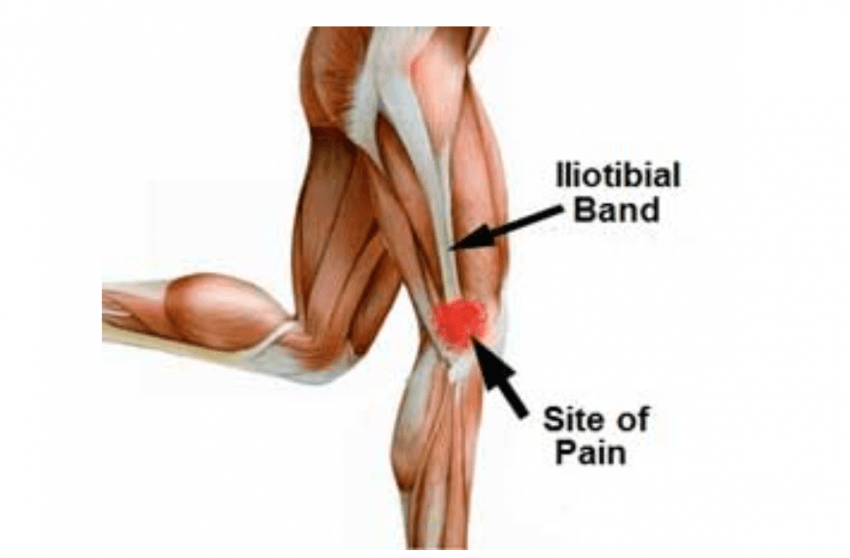

Tensor Fascia Lata (TFL) is one of our hip flexors. This muscle sits laterally on our hips, attaching to the bony prominence, the Anterior Superior Iliac Spine (ASIS), which is easily palpable, especially in lean runners. What makes this muscle especially important for runners is that it then runs inferiorly and blends into the Iliotibial Tract (ITB). Muscles generally have a tendon at each end which attaches them from one bone to another. The TFL is one of a few exceptions as it blends into the ITB rather than its own tendon. It also shares the ITB with the Gluteus Maximus, which has a similar blending of some of its fibres into the ITB.
This muscle flexes the hip (brings the knee up) as well as abducting the thigh (takes it laterally away) and medially rotates the thigh (turns the thigh in). Although this muscle is quite small, it certainly punches beyond its weight. The reason for this is its attachment into the ITB. The ITB is well known to many runners, usually for all the wrong reasons.
The ITB is a non-contractile piece of tissue. This means it can't become 'tight' of its own accord. However, with the TFL attaching into it, if the TFL becomes tight, it will pull on the ITB and hence tighten it (note that the Gluteus Maximus also does this).
Most runners would recognise that an over-tight ITB is not favourable, as this can cause lateral knee pain. Hence, keeping your TFL as flexible as possible, decreasing the pull it has on the ITB, will decrease your chance of lateral knee pain caused by ITB tightness.
Runners who get treated regularly will be familiar with how tight the TFL can become. Obviously this muscle is utilised constantly during running and unless looked after, it will haunt you.
So how do we stretch this little critter? Well, like all stretches, we simply take the actions of the muscle and reverse them. This means we need to take the thigh into hip extension, slight adduction and lateral rotation.
When you get into this position, make sure you squeeze your glutes to affect posterior rotation of your pelvis. To get a little more out of this stretch, try leaning to the opposite side, away from the leg you are stretching. Also important is to make sure you don't lean forward on this stretch. This will subtly turn the stretch into an adductor stretch. Instead, keep the leg you are stretching perpendicular to the floor and gently arch your back — this will again enhance the TFL stretch.
Stretching this muscle before and after running is recommended. Stretching beforehand will enable good hip extension. Stretching after running will re-establish any lost flexibility during running, decreasing the chance of tightening the ITB and possible lateral knee pain.