

Anatomy
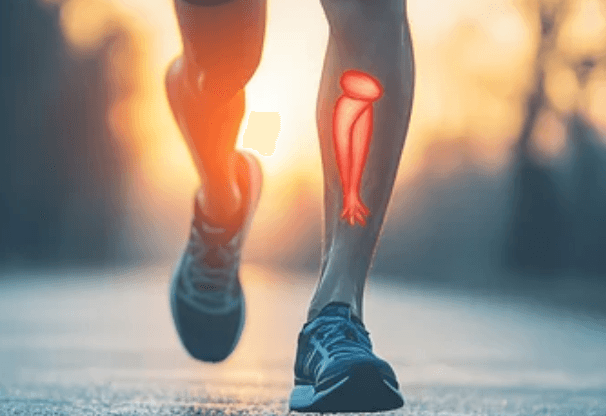
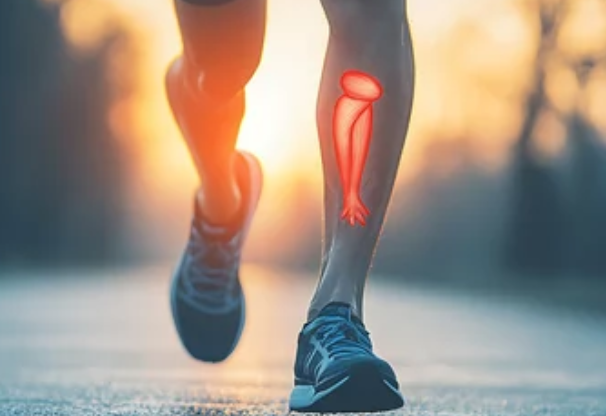
The Tibialis Posterior (Tib Post) originates on the medial (inner) surface of the posterior (behind) tibia. It also has minor attachments to the fibula and to the interosseous membrane (fascia that lies between the tibia and fibula). Hence the Tib Post begins deep and medial to your lower leg muscles (gastrocnemius and soleus). It then descends down the medial shin, where it becomes tendon (a flat sheet of tendon) that travels behind your medial malleolus (inside ankle). It then attaches to a number of little bones in the arch of your foot, predominantly your navicular.
Function
The Tib Post is a running necessity. Although the basic action of the Tib Post is to plantar flex (point the toe) and invert the ankle (turn the ankle inward), the importance to running is its ability to sustain the longitudinal arch of the foot (stops too much pronation – flat foot). Everyone needs to pronate as a normal part of your running gait, but too much pronation, or pronating too fast without control, will eventually cause problems. Your Tib Post helps control the rate of pronation as well as the amount of pronation.
Pathologies / injury
Too much pronation or increased rate of pronation is attributed to many lower leg and foot injuries. One very well known to runners is medial tibial stress syndrome or 'shin splints'. If the Tib Post is not functioning correctly, its attachment to the tibia can 'pull' on the bony surface (periosteum) causing an inflammation of this tissue and hence shin pain. If the Tib Post is over-active it may cause this condition — too tight. Interestingly, if the Tib Post is under-active it may also cause this condition as the foot will over-pronate at a rapid rate, causing excessive tension on the medial shin. Hence, the Tib Post should be maintained in a healthy state to avoid both over and under activity.
Another common condition for this muscle is tendonitis (tendon inflammation) and tendinosis (tendon degeneration). This begins as a mild ache behind the medial malleolus that warms up with running but returns after rest and in the morning. As this progresses it can become a sharp pain behind the inside ankle bone that will stop you from running. Pain can sometimes be felt at the attachments of the Tib Post on the navicular or in the arch of the foot. Swelling may be seen behind the inside ankle bone. In this situation, your acute inflammatory care should take place. Consult your health advisor for 'what to do'.
Self treatment
Self treatment for this condition comprises self massage to the muscle belly about the tibia attachment and Tibialis Posterior strengthening exercises.
Self massage attempts to reduce any fascial adhesions that may be occurring with the periosteum of the tibia and other musculature. This is achieved by creating a shear force with your fingers over the medial shin. If you cross the affected leg over the other leg (while sitting) you have easy access to your medial shin. Make sure the foot dangles over your other leg to allow the Tibialis Posterior to be on a mild stretch. Using your thumb (no lubricant), slide your thumb slowly from just above the ankle towards your knee, directly behind the tibia. The pressure is not straight down but at an angle of approximately 15 degrees into the muscle towards your knee. This will create enough shear force to mobilise any adhesions. A burning feeling is normal and desirable! About 8 slow slides should be enough in any one session.
Secondly, start your thumbs on the tibia in the same position — no lubricant. Slowly allow your thumbs to fall off the tibia onto the softer muscle tissue and imagine you are trying to push the muscle away from the bone, again creating that burning and/or aching feeling. Hold at this point for 5 seconds. Move from the base of the tibia towards the knee, stopping every few centimetres. Don't avoid the sore bits as these are the probable areas of concern.
Thirdly, this time with some lubricant if you wish, glide your thumb from just above the ankle towards your knee, working deep into the muscle belly — deep enough to feel the pressure is achieving something. Ten glides just medial to the tibia will be ample in any one session.
Now for strength. There are many opinions on just how to strengthen this muscle. This is the author's version and by no means the best or most correct. When the mid foot begins to collapse during running/walking without adequate braking forces from the Tibialis Posterior, problems begin to occur. Hence, we need to re-educate the Tibialis Posterior to fire when necessary. This process is best taught in a one-on-one clinical setting, but for beginners, try this:
- Sit on the edge of a chair with your arms resting on your knees.
- Begin the exercise by raising the arch of the affected foot. Use your good side to get the idea.
- Once the arch is raised, gently push your big toe joint into the floor without losing the arch in your foot.
- Now, keeping the above two points sustained, wiggle your big toe. Hard? Very. This helps isolate the Tibialis Posterior rather than using your flexor hallucis to hold your foot in this high arch position.
- Now lean forward off your chair slightly to put some weight on your foot. Keep the arch! Don't allow your big toe to dominate the stability either.
- Once mastered you will wonder why you thought it was difficult. This is the first step to rehabilitating your Tibialis Posterior.
There are numerous taping techniques you can use while your Tib Post is not functioning correctly. These are best taught by your health professional.
Summary
The Tib Post is a small but very important foot stabiliser in running and walking. If it becomes tight or weak, it will eventually cause problems about that area, either directly to its own tendon or to the shin or medial arch of the foot. Keep it healthy with regular self massage and strengthening exercises.
Happy running.